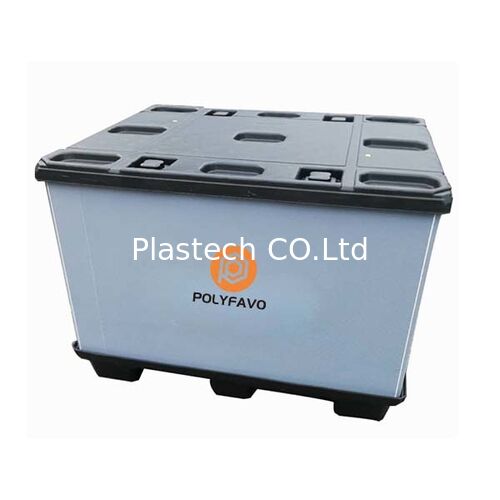
Pallet Sleeve Box Solution for Automotive Parts
Protect valuable automotive components, improve line-side handling and reduce empty-return volume by up to 80% with a reusable pallet sleeve box engineered around your parts and logistics route.
POLYFAVO develops customized automotive returnable packaging for OEMs, Tier 1 and Tier 2 suppliers, parts manufacturers, warehouses and third-party logistics providers.
What Is a Pallet Sleeve Box for Automotive Parts?
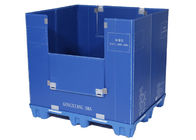
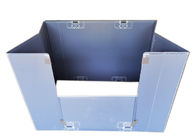
A pallet sleeve box for automotive parts is a collapsible returnable packaging system consisting of three main components:
Customized dividers, fabric pockets, foam, thermoformed trays or other dunnage can be installed inside the container to separate and protect each automotive component.
After unloading, the PP sleeve folds flat between the pallet and lid. Multiple empty systems can then be stacked together for storage or return transportation, significantly reducing the space occupied by empty packaging.
Packaging Challenges in the Automotive Supply Chain
Automotive components may pass through several factories, warehouses and assembly stations before installation. Poor packaging can result in scratches, deformation, contamination, mixed parts and costly production delays.
Common packaging challenges include:
-
Damage to painted, polished or Class A surfaces
-
Part-to-part contact during transportation
-
Inefficient loading of irregular components
-
High consumption of disposable cartons and wooden crates
-
Excessive space required for empty packaging
-
Difficult line-side access and parts picking
-
Missing labels or mixed production batches
-
Electrostatic discharge risks for electronic components
-
Inconsistent packaging sizes across different suppliers
A customized pallet sleeve box addresses these problems with a reusable outer container and part-specific internal dunnage.
A Complete Automotive Returnable Packaging System
| Component |
Recommended Configuration |
Function |
| Pallet and lid |
Thermoformed, blow-molded or injection-molded HDPE |
Provides a stable, stackable base and protects the load from the top and bottom |
| Folding sleeve |
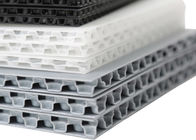
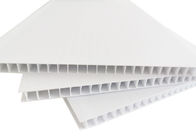
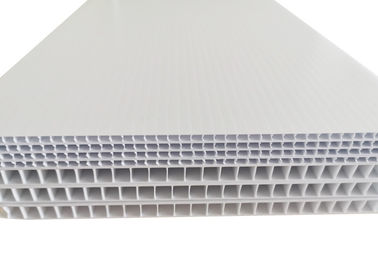
10–12 mm double-layer PP honeycomb panel |
Forms a lightweight, impact-resistant and moisture-resistant container wall |
| Internal dunnage |
PP dividers, fabric pockets, foam or thermoformed trays |
Separates parts and prevents movement, collision and surface damage |
| Loading door |
Foldable access flap with hook-and-loop closure |
Allows operators to load or pick parts without removing the entire sleeve |
| Locking system |
Plastic locks, sliding locks or lashing belts |
Helps keep the pallet, sleeve and lid securely assembled |
| Identification |
Label holder, card pocket, screen printing or QR code |
Supports part identification, traceability and warehouse management |
| Optional protection |
ESD, conductive, flame-retardant or UV-resistant materials |
Meets special handling and operating requirements |
Packaging Configurations for Different Automotive Parts
Heavy Metal and Machined Components
Engine parts, gearbox housings, brake components, castings and machined metal parts require high structural strength and effective load distribution.
Recommended configuration:
-
Reinforced HDPE pallet
-
High-density PP honeycomb sleeve
-
PP grid dividers or thermoformed trays
-
Anti-slip pads or shaped supports
-
Validated stacking and dynamic load capacity
Painted and Decorative Parts
Interior trim, exterior decorative components, painted panels and polished plastic parts are vulnerable to scratches and surface marks.
Recommended configuration:
-
Soft fabric pocket dunnage
-
Nonwoven or foam contact surfaces
-
Individual cells for each component
-
Dust-resistant lid and sleeve construction
-
Wide loading door for controlled handling
Automotive Electronics and Sensors
ECUs, sensors, electronic modules and other sensitive parts may require electrostatic discharge protection.
Recommended configuration:
-
ESD or conductive PP materials
-
Anti-static dividers or trays
-
Grounding points when required
-
Clearly marked ESD identification
-
Surface-resistance target customized to the customer’s specification
Large Interior and Exterior Components
Door trims, seat components, dashboards, bumpers and long plastic parts often waste space in standard boxes.
Recommended configuration:
-
Customized pallet footprint and sleeve height
-
Tall foldable sleeve
-
One-piece, two-piece or C-shaped sleeve construction
-
Side loading door
-
Hanging fabric pockets or shaped dunnage
Small Mixed Components
Fasteners, brackets, connectors and small assembled parts need clear separation and accurate quantity control.
Recommended configuration:
Key Benefits for Automotive Manufacturers
Better Part Protection
Part-specific dunnage holds each component in a controlled position. It reduces movement, part-to-part contact, scratching and impact damage during handling and transportation.
Up to 80% Less Empty-Return Volume
The sleeve folds flat after unloading. Pallets, lids and folded sleeves can be consolidated for return transportation, helping reduce empty truck space and reverse-logistics costs.
Actual return ratio depends on container height, folding design and loading plan.
Lower Packaging Cost per Trip
Unlike disposable cartons or wooden packaging, pallet sleeve boxes can be used repeatedly. A properly designed system can reduce long-term expenditure on one-way packaging, waste disposal and replacement materials.
Improved Line-Side Handling
Optional loading doors provide easier access to lower parts. Operators can pick components without lifting off the complete sleeve, improving ergonomics and production-line efficiency.
Efficient Warehouse Storage
Standard pallet footprints simplify stacking, forklift handling and warehouse planning. Folded packaging occupies less storage space when it is not in use.
Moisture and Chemical Resistance
PP and HDPE components do not absorb moisture like corrugated cardboard. They are resistant to many oils, greases and industrial chemicals commonly encountered in automotive operations.
Reusable and Recyclable Materials
The main PP and HDPE components can be reused over many transport cycles and recycled at the end of their service life, subject to local recycling conditions and the accessories installed.
Typical Technical Specifications
| Item |
Available Specification |
| Common pallet footprints |
1200 × 800 mm, 1200 × 1000 mm or customized |
| Sleeve material |
Double-layer PP honeycomb panel |
| Common sleeve thickness |
10 mm or 12 mm |
| Common sleeve weight |
Approximately 2500–4000 g/m², selected according to load requirements |
| Sleeve construction |
One-piece, two-piece, C-shaped or customized |
| Folding styles |
M-fold, Z-fold or customized hinge positions |
| Edge finishing |
Round sealed edge, flat sealed edge or profile-reinforced edge |
| Operating temperature |
Approximately –20°C to +55°C, subject to material configuration |
| Colors |
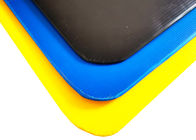
Grey, black, blue or customized colors |
| Printing |
Screen printing, UV printing, logos, handling marks and identification |
| Access options |
Loading door, observation window or removable panel |
| Dunnage |
PP dividers, textile pockets, foam, EPP or thermoformed trays |
| Special materials |
ESD, conductive, UV-resistant or flame-retardant options |
| Load and stacking capacity |
Determined and validated according to box structure, pallet, sleeve density, contents and handling conditions |
How We Develop Your Automotive Packaging
1. Collect Part and Logistics Information
We review:
-
Part drawings and photographs
-
Part dimensions and weight
-
Quantity required per container
-
Contact surfaces that must be protected
-
Loading and unloading method
-
Forklift or pallet-jack requirements
-
Stacking height and transportation conditions
-
Factory-to-factory return route
-
ESD, flame-retardant or cleanliness requirements
2. Design the Packaging Concept
Our team determines the appropriate pallet footprint, sleeve thickness, folding position, loading door and internal dunnage.
The objective is to balance part protection, packing density, operator access and return efficiency.
3. Produce a Prototype
A prototype can be produced to check part fit, loading sequence, dunnage position and operator access before mass production.
4. Validate the Packaging
Depending on project requirements, validation may include:
5. Begin Mass Production
After the sample and specifications are approved, we manufacture the sleeve, pallet, lid, dunnage and accessories according to the confirmed design.
Typical Design Example
A supplier needs to transport fragile automotive trim parts between its molding factory and an assembly plant.
A suitable packaging concept may include:
-
1200 × 1000 mm HDPE pallet and lid
-
10 mm double-layer PP honeycomb sleeve
-
Wide front loading door
-
Soft hanging fabric pockets
-
Individual storage positions for every part
-
External label holder
-
Printed part number and return instructions
The fabric pockets prevent direct contact between components, while the loading door allows operators to remove parts in sequence. After unloading, the sleeve and pocket assembly can be folded for return transportation.
This is a design example only. Final specifications must be based on the actual parts, load and logistics conditions.
Evaluate Total Packaging Cost, Not Only Purchase Price
For a returnable packaging project, the lowest initial price does not always provide the lowest operational cost.
Automotive customers should compare:
Packaging cost per completed trip = purchase cost + return freight + cleaning + repairs + losses ÷ completed transport cycles
A well-designed pallet sleeve box can improve packing density, reduce damage and lower empty-return volume. These savings may be more valuable than a small difference in the initial container price.
Why Choose POLYFAVO?
Zhongcheng (Qingdao) New Material Co., Ltd., the manufacturer behind POLYFAVO, has specialized in PP honeycomb panels, pallet sleeve boxes and PP corrugated packaging since 2014.
Our capabilities include:
-
5,500+ m² manufacturing facility
-
ISO 9001 and IATF 16949-certified quality systems
-
PP honeycomb panel extrusion and lamination
-
Sleeve cutting, edge sealing, hole punching and folding
-
Loading-door production and butt welding
-
Logo printing and label installation
-
Customized dividers and protective dunnage
-
OEM and ODM packaging development
-
Support for prototype and production orders
By producing both the PP honeycomb material and the finished sleeve, POLYFAVO can control material selection, sleeve structure and converting quality throughout the project.
Frequently Asked Questions
1. What automotive parts can be packed in a pallet sleeve box?
Pallet sleeve boxes can be developed for metal castings, machined components, lamps, sensors, electronic modules, trim panels, seat parts, dashboards, bumpers and many other automotive components. The internal dunnage is designed around the specific part.
2. What is the difference between a pallet sleeve box and a standard pallet box?
A standard rigid pallet box maintains its full volume when empty. A pallet sleeve box has a folding middle sleeve that can be collapsed between the pallet and lid, reducing empty storage and return volume.
3. Can you design custom dunnage?
Yes. Available solutions include PP dividers, fabric pockets, foam inserts, EPP components and thermoformed trays. The selection depends on the part shape, weight, surface and loading method.
4. Can the container be made with ESD protection?
Yes. ESD or conductive PP materials can be used for electronic components. The required surface-resistance range should be confirmed before production.
5. How much weight can the box carry?
Load capacity depends on the pallet structure, sleeve thickness, panel weight, box height, dunnage and stacking conditions. POLYFAVO recommends validating the complete loaded container instead of relying only on a general material rating.
6. Can a loading door be added?
Yes. A loading door can be installed on the long or short side. Its size, position and closure can be customized for operator access and part removal.
7. How much return space can be saved?
A collapsible system can reduce empty-return volume by up to approximately 80%. The actual ratio depends on the assembled height, folded thickness and container loading plan.
8. What information is required for a quotation?
Please provide the part drawing or photographs, dimensions, weight, quantity per box, annual demand, transport route, stacking requirements, handling equipment and any ESD, flame-retardant or surface-protection requirements.
Request Your Automotive Packaging Proposal
Tell us what automotive components you need to protect. Our team will recommend the pallet size, PP sleeve structure, dunnage, access door and loading arrangement for your logistics system.
Please send:
-
Part drawings or clear photographs
-
Part dimensions and weight
-
Required quantity per container
-
Preferred pallet footprint
-
Stacking and handling requirements
-
Transport and return route
-
Annual packaging quantity
-
ESD, flame-retardant or other special requirements


 Your message must be between 20-3,000 characters!